

Studio 54 had been a phenomenon.
For a few extraordinary years, Ian Schrager and Steve Rubell had created more than a nightclub. They had created a world people desperately wanted to enter.
The music mattered.
The design mattered.
The people certainly mattered.
But what made Studio 54 extraordinary was harder to define.
It was the feeling of being there.
Then it was over.
And Schrager found himself wondering what came next.
Studio 54 had taught Schrager and Rubell something about people.
Give them the right room, the right music, the right energy, and the right mix of people—and the room itself could become the attraction.
When Studio 54 ended, Schrager wasn’t a hotelier looking for his next property.
He was looking for what might come next.
And somewhere in that search, the hotel became intriguing.
What if some of the energy of Studio 54 could live somewhere else?
The feeling.
The people.
The music.
The electricity of walking into a room and knowing something was happening.
What if a hotel could do that?
What if the lobby wasn’t simply somewhere you passed through on the way to your room?
What if it became the living room?
The gathering place.
The dance floor, so to speak.
A place where guests mixed with locals. Where people came even when they weren’t sleeping upstairs. Where the energy of the people inside became as important as the design around them.
Hotels didn’t really behave that way then.
There was no boutique playbook.
No lifestyle category.
No roadmap for turning the social energy of a nightclub into the public life of a hotel.
Just the possibility that a hotel could be something more than a place to sleep.
And a question:
What if?
The answer was Morgans.
A hotel Schrager has described simply as the kind of place he and his circle wanted to stay in.
He wasn’t trying to invent boutique hospitality.
There was no category to invent yet.
He was taking something he understood—the power of people, energy, design and gathering—and translating it into something that hadn’t existed before.
Not replicating Studio 54.
Translating its energy.
That distinction matters.
Because translation preserves an idea.
Replication copies a formula.
Schrager wasn’t alone.
André Balazs would create hotels that felt inseparable from the places they inhabited.
Chateau Marmont became part of the mythology of Hollywood.
The Mercer belonged to SoHo.
His hotels didn’t simply occupy places.
They absorbed them.
They had personalities.
Opinions.
Even imperfections.
Neither founder was chasing a category.
They were creating places they themselves wanted to experience.
The boutique hotel movement wasn’t born from a strategy deck.
It was born from taste.
And taste is remarkably difficult to scale.
The generation that followed—Thompson Hotels, Joie de Vivre, Ace Hotel, Bunkhouse, The Standard and others—interpreted that idea in their own ways.
Each had a personality.
A sense of place.
A point of view.
They certainly intended to grow.
But growth wasn’t the identity.
It was the consequence of creating something people genuinely wanted.
SoHo Grand wasn’t trying to recreate Morgans.
It was trying to become SoHo.
The greatest boutique hotels weren’t designed to look alike.
They were designed to belong.
Somewhere along the way, however, the industry changed.
Many of those independent brands became collections.
Collections became portfolios.
Portfolios became acquisitions.
Scale became both the reward for success and, sometimes, the challenge that followed it.
None of that is inherently bad.
In fact, it’s often inevitable.
The industry’s largest companies noticed what independent hoteliers had created.
And they wanted in.
Marriott acquired Starwood, bringing W Hotels into the world’s largest hotel company.
Hyatt has assembled one of hospitality’s most formidable lifestyle portfolios through acquisitions that brought Thompson Hotels, Dream Hotels, The Standard and Bunkhouse into its orbit.
I don’t see those acquisitions as admissions of failure.
Quite the opposite.
They are acknowledgements.
The independents had proven something.
Originality had value.
Culture had value.
Neighborhood mattered.
Authenticity had value.
Enough value to acquire.
And that’s where the story becomes complicated.
Because what happens after the acquisition?
A company buys a hotel or brand precisely because it doesn’t feel like everything else.
Then the machinery of scale begins.
Technology gets integrated.
Procurement gets consolidated.
Standards are introduced.
Reporting structures change.
Loyalty platforms arrive.
Efficiencies are found.
Risk is reduced.
Consistency becomes increasingly important.
None of those things are unreasonable.
Most are simply good business.
But almost every one of them places pressure on the irregularities that made the original interesting in the first place.
The local amenity.
The eccentric design decision.
The restaurant that doesn’t quite fit the model.
The general manager empowered to make a decision without calling someone three time zones away.
The bartender who knows the neighborhood better than the brand office ever could.
At scale, those things can begin to look like inefficiencies.
They may also be the asset.
Boutique hospitality was created, in many ways, as an antidote to standardization.
Then the hotel industry figured out how to standardize boutique hospitality.
We got very good at recreating the signals.
The lobby playlist.
The locally roasted coffee.
The books arranged just so.
The vintage furniture.
The neighborhood guide.
The craft cocktail.
The carefully imperfect typography.
A hotel can look independent without actually being independent at all.
Which raises an uncomfortable question:
If an independent hotel is acquired by a global hotel company, is it still authentic?
I don’t think the answer is always yes.
Not because corporate ownership automatically makes a hotel bad.
It doesn’t.
But corporate ownership can change things overnight.
Authenticity usually disappears one decision at a time.
Years later, I found myself sitting on the porch of the Kelley House on Martha’s Vineyard with Jason Brown and Brad Guidi of Blue Flag.
Blue Flag had begun acquiring a collection of historic independent hotels across Martha’s Vineyard and Nantucket—places with history, character, and deep relationships to the islands around them.
The Kelley House would become Faraway Martha’s Vineyard. The Roberts Collection would become Faraway Nantucket. Life House Nantucket, Blue Iris, The Beachside and others would follow as part of a growing portfolio.
They weren’t simply buying hotels.
They were setting out to reimagine them.
And they were looking to me to help operate that vision—to take what existed on paper, in renderings and in conversations like this one, and help turn it into the experience guests would actually feel.
One evening, Jason, Brad and I sat on the porch of the Kelley House.
Three glasses.
A bottle of wine.
The conversation drifted toward what these hotels could become.
I asked Brad what kind of hotels they were setting out to create.
His answer couldn’t have been simpler.
“The kind of hotels we’d want to hang out in with our friends.”
I remember smiling.
Decades after Schrager had imagined a hotel he and his friends might actually want to stay in, here I was on an island off Massachusetts listening to a new generation of hotel owners describe almost the same instinct.
Not a demographic.
Not a prototype.
Not a brand standard.
A feeling.
For someone who had spent a career admiring the boutique hotel movement—from Ian Schrager and André Balazs to Tony Fant and the Stern family—there was something surreal about no longer observing those conversations from a distance.
I was sitting inside one.
And this time, I had been asked to help bring the idea to life.
I remember thinking:
I can’t believe I get to be part of this.
Like every ambitious company, Blue Flag eventually entered a different chapter.
The hotels were beautiful. They were reimagining hospitality on Martha’s Vineyard and Nantucket with an extraordinary level of design, personality, and intention.
But beautiful hotels are expensive to build.
Construction schedules slipped.
Costs rose.
Budgets were tested.
And investors, understandably, needed to see a path to return.
The conversations began to change.
Brad was one of the most instinctive creative minds I’d ever worked with. He approached hotels personally—through design, feeling, and the conviction that something extraordinary was worth fighting for.
Jason carried a different responsibility.
As the business grew, he also had to answer to investors, financial performance, construction realities, and the economics required to make that creativity sustainable.
Neither was wrong.
In fact, great hotels probably require both.
But I began to understand something I hadn’t fully appreciated while we were drinking wine on that porch.
Creativity gets to ask:
What could this become?
Capital eventually has to ask:
What will it cost?
And growth adds a third:
When will it return?
Those aren’t cynical questions.
They’re necessary ones.
But they change the conversation.
The pressure to finish the current hotel begins competing with the freedom to imagine the next one.
And somewhere between construction budgets, opening delays, investor expectations, and operating performance, a remarkably simple question becomes much harder to protect:
“What kind of hotels would we want to hang out in with our friends?”
I’ve thought about that tension ever since.
Growth has a way of replacing imagination with justification.
Not because founders suddenly lose their vision.
Because eventually, vision has to answer to reality.
Construction costs.
Operating performance.
Investors.
Time.
The first hotel gets to ask:
What should exist?
The tenth has to ask:
What can we afford to repeat?
Those are profoundly different questions.
A successful hotel proves that something worked.
It doesn’t necessarily tell you which part of it should be repeated.
Which brings me to a question I think more hospitality companies should be willing to ask:
Has the brand earned the right to scale?
Not simply financially.
Creatively.
Culturally.
Operationally.
Does it understand why the first hotel mattered?
Does it know what must remain sacred?
More importantly, does it know what shouldn’t be repeated at all?
Can the next hotel belong to its neighborhood as completely as the first?
Can a hundred hotels share a philosophy without sharing a personality?
And when an independent brand is acquired, perhaps the question belongs to the new owner too:
Have you earned the right to change it?
Scale wants consistency.
Authenticity requires specificity.
That’s the tension.
And while authenticity can survive scale, after nearly thirty years in this industry, I’ve come to believe it’s the exception rather than the rule.
Rarely does it disappear all at once.
A decision here.
A standard there.
An efficiency that makes perfect sense on paper.
Another approval.
Another compromise.
Until one day the hotel still looks independent.
It still sounds independent.
It may even still call itself independent.
But it no longer behaves independently.
And something feels different.
The thing that made it interesting has been polished away.
Which brings me back to that porch on Martha’s Vineyard.
Three people.
A bottle of wine.
And a remarkably simple idea:
“The kind of hotels we’d want to hang out in with our friends.”
What I understand now that I didn’t fully understand then is how difficult that sentence becomes once you’re responsible for actually building it.
Creativity has to meet capital.
Vision has to meet operations.
Ambition has to meet return.
That’s not where authenticity fails.
That’s where it gets tested.
Maybe that’s the idea worth protecting.
Because the real test of scale isn’t whether you can build the next hotel.
It’s whether the reason you built the first one can survive it.
Schrager started with a question:
What if?
Maybe success requires an equally important one:
Have we earned the right to do it again?
Continue the Conversation
Every Field Note begins with curiosity. If this one resonated with you, these conversations, places, and experiences are well worth exploring.
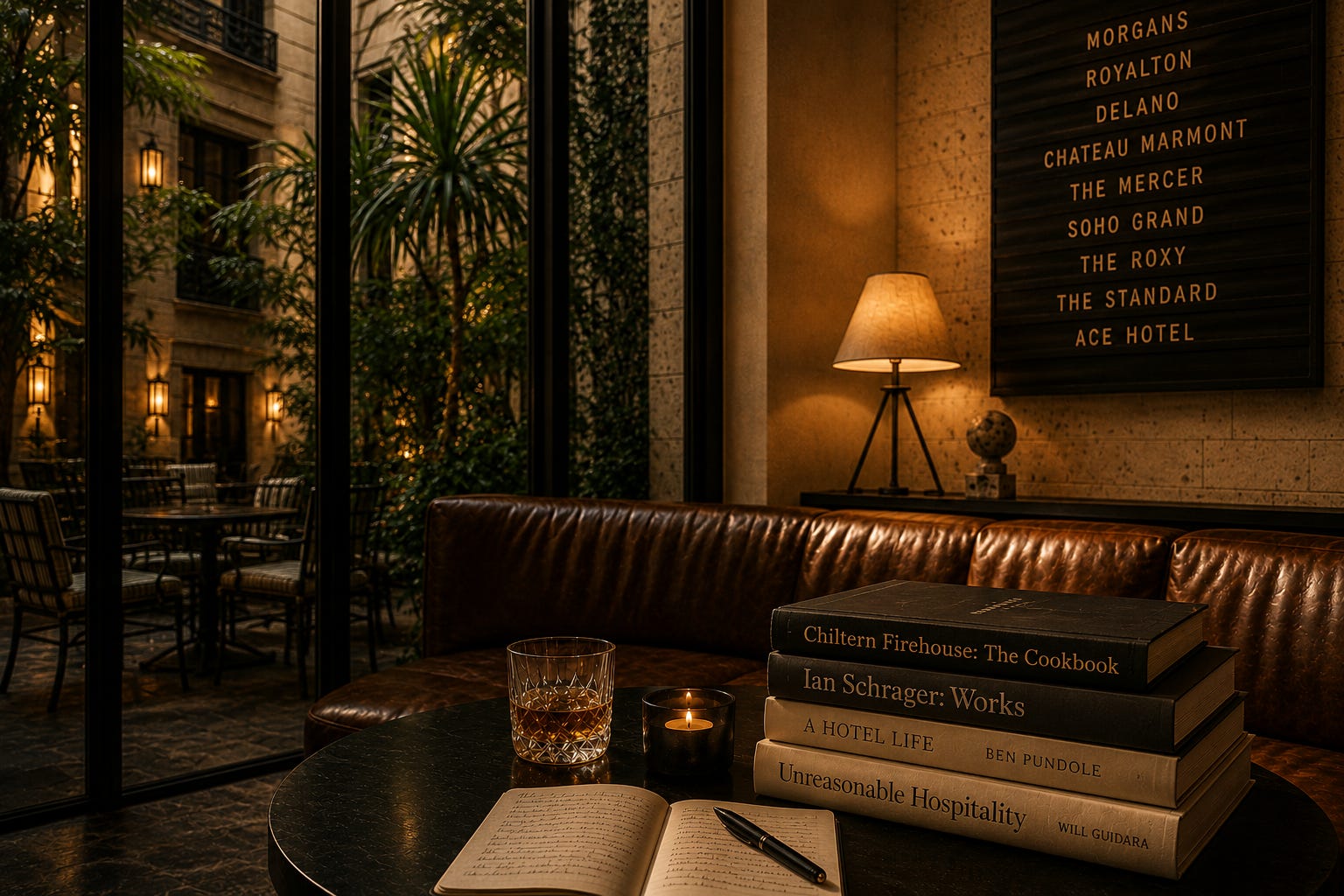
Ian Schrager — A Hotel Life
The interview that inspired this essay (thank you Ben Pundole for keeping us curious)
https://www.ahotellife.com/ian-schrager/
André Balazs Properties
Explore the philosophy behind properties like Chateau Marmont and The Mercer.
https://www.andrebalazsproperties.com
Ian Schrager Company
Schrager’s reflections on creativity, design, and hospitality.
https://www.ianschragercompany.com/company
If You’re Visiting New York
Start with a cocktail at Grand Bar & Salon, catch live jazz at The Django, and explore ARTSPACE at PUBLIC Hotel.
https://www.sohogrand.com/dining/grand-bar/
https://www.thedjangonyc.com
https://www.publichotels.com/newyork/eat-and-drink/artspace
Heading to Martha’s Vineyard?
Spend an evening at The Pelican Club at Faraway Martha’s Vineyard.
https://www.farawaymarthasvineyard.com/pelican-club
Stay curious.