
Nobody Asked Housekeeping
What happens when hotel operations enters the design conversation too late.

Justin and I could talk about hotel design for hours.
Probably longer than anyone would care to listen.
We love great architecture.
Thoughtful interiors.
Restaurants that make you order one more drink simply because you aren’t ready to leave.
Hotel lobbies that somehow feel exciting and comfortable at exactly the same time.
Neither of us is an interior designer.
We know that.
But after spending our careers opening and operating hotels, we’ve developed an enormous respect for the people who understand how to shape a space.
We’ve also learned something else.
The most expensive design mistakes are often the ones a guest will never see.
We’ve operated hotels where owners gave designers carte blanche, with little context from the people who would eventually have to run the building.
Operations entered the conversation too late.
By then, the drawings were finished.
The millwork was underway.
The spaces were beautiful.
And we started asking questions.
Where is the refrigeration?
Where do we store the glassware?
Where do the linens go?
Where does housekeeping keep cleaning supplies?
How does a server move through this space on a Saturday night?
What happens when 30 guests arrive at the same time?
The answers were often expensive.
We’ve added refrigeration at the last minute because a restaurant didn’t have enough.
We’ve searched for glass storage in bars designed without enough space.
We’ve watched owners sacrifice linen closets and housekeeping storage to create one more guest room.
On paper, the math probably looked compelling.
One more key.
One more room to sell.
One more line of revenue.
But hotels don’t operate on paper.
The housekeeping team still needs linen.
They still need towels.
They still need cleaning supplies.
So storage gets moved somewhere else.
Sometimes down the hall.
Sometimes to another floor.
Sometimes, as we’ve experienced, three buildings away.
Now imagine a room attendant responsible for turning thirteen rooms during a shift.
Every trip for linen takes longer.
Every missing towel creates another walk.
Every forgotten supply adds another few minutes.
The team moves faster.
Then faster.
The pressure builds.
And eventually, a guest is standing at the front desk at check-in time hearing the words no hotel wants to say:
“Your room isn’t quite ready.”
The guest sees a late room.
The owner sees a housekeeping problem.
We see a design decision made years earlier.
That’s the part of hotel design that fascinates us.
A decision measured in square feet during development can eventually be measured in labor hours, employee exhaustion, guest frustration, service recovery, and lost loyalty.
Bad operational design sends an invoice every day.
We’ve seen the same thing in restaurants.
A four-star restaurant.
One hundred and forty seats.
A beautiful dining room.
And a kitchen so undersized that the culinary team struggled to execute fine dining service for seventy guests.
The dining room promised one experience.
The kitchen had been designed to deliver another.
No amount of training fixes that.
No pre-shift meeting fixes that.
No passionate chef can permanently outwork a floor plan.
And yet, too often, we ask hotel and restaurant teams to do exactly that.
We call it hustle.
We call it urgency.
We call it hospitality.
Sometimes it’s simply a team compensating for a building that was never designed to support them.
Those experiences changed the way Justin and I think about design.
They also made us love good design even more.
Because we’ve had the privilege of working with designers who approached the process very differently.
Jenny Bukovec is one of them.
Jenny has a rare ability to think about interiors as a fully sensory proposition.
How a space looks.
How it sounds.
How it moves.
How the brand lives inside it.
And, importantly, how the people responsible for operating that space will actually use it.
During our work at Faraway Nantucket, she asked questions.
Real questions.
What does operations need?
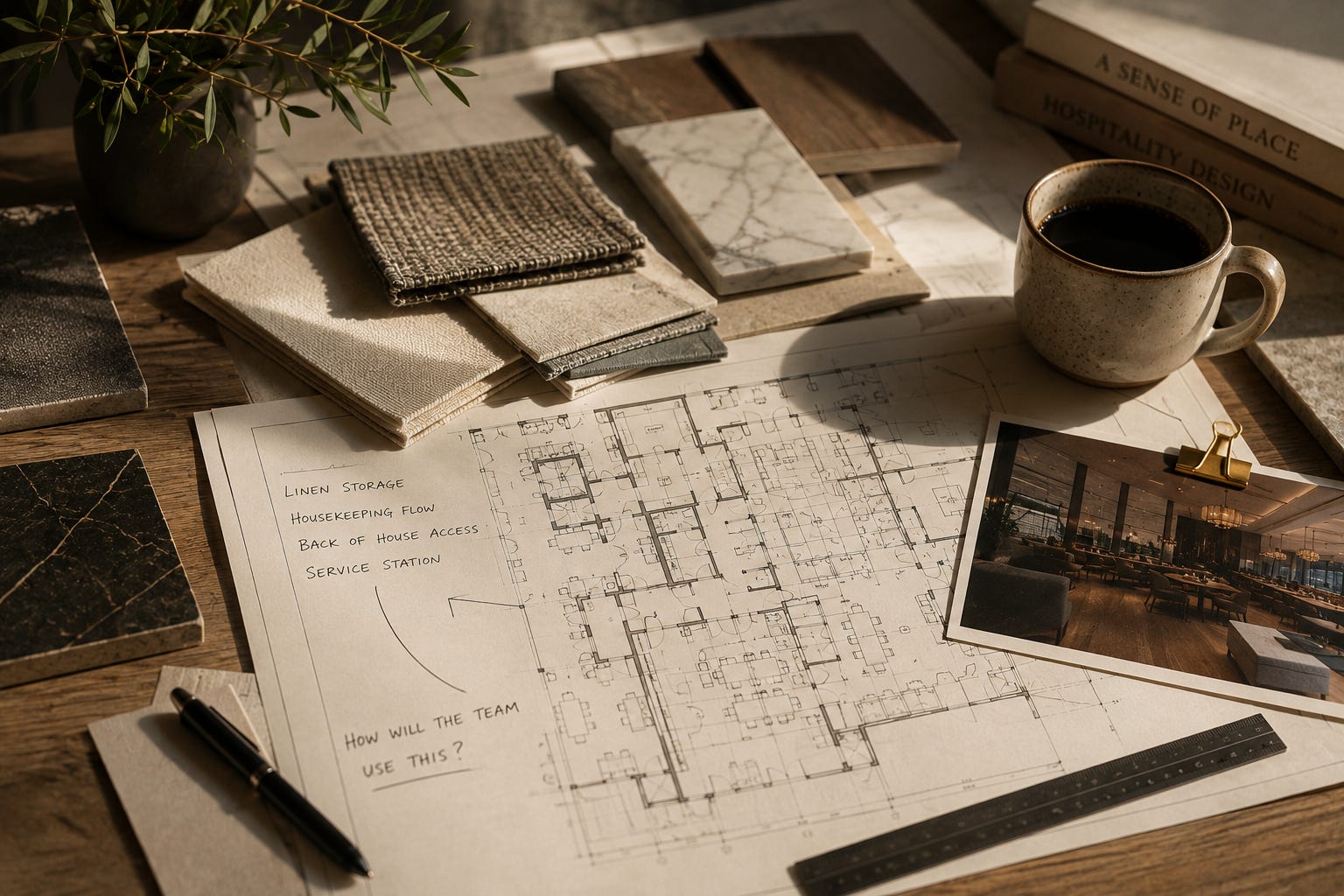
How will the team use this?
Where does this go?
What happens here during service?
It sounds simple.
It isn’t.
Those conversations stimulated something in both Justin and me.
The more Jenny invited us into the design process, the more interested we became in design itself.
We started looking at spaces differently.
A few inches could change how a bartender moved.
A sight line could help a front desk associate recognize a guest before the guest reached the desk.
The placement of storage could quietly give a room attendant hours back over the course of a week.
A service station could either support the choreography of a dining room or interrupt it all night.
Suddenly, design wasn’t simply what surrounded the operation.
Design was shaping the operation.
And the best part was that our operational input didn’t diminish the creative vision.
It protected it.
That is the misconception we want to challenge.
Operators should not be invited into the design process to tell designers how to design.
We should be there to help answer a different question:
Can the hotel actually live beautifully inside this idea?
The most exciting projects of our careers have been the ones where the answer was developed together.
Designer.
Owner.
Developer.
Operator.
Different disciplines.
Different perspectives.
One hotel.
That is a significant part of why we created Precursor Hospitality.
We want to be in the room before the change order.
Before the refrigerator has nowhere to go.
Before the glassware arrives.
Before the linen closet becomes another guest room.
Before a team member has to walk three buildings away for towels and is later asked why room thirteen wasn’t ready by check-in.
Because by the time the guest feels the problem, the design decision was often made years ago.
Great design should be celebrated.
Protected.
Given every opportunity to succeed.
And sometimes the best way to protect a beautiful idea is to invite the people who will have to bring it to life into the room early enough to matter.
Good design is beautiful.
Great design lets hospitality happen.
So well said, my friend! We have run into this situation many times: we are handed a "completed" space, and then we are supposed to be off to the races to make it function, only to find all the spatial issues.
To the general public reading this - THIS is why we started Precursor Hospitality - to work with owners/developers and the design team, including the architect of record, to avoid the trap of prioritizing beauty over function. Our goal is to identify and address any potential design issues that conflict with the day-to-day realities of operating a space.
FORM + FUNCTION = harmonious space
And of course, there are the financial implications of not getting this correct, right out of the gate. According to a large AIA analysis of 18,229 completed U.S. building projects, change orders increased project cost by an average of approximately 3.2%–5.04%, depending on project size. However, the upper boundary of the “typical” middle 80% of projects was approximately 13%–16%, meaning a 10%+ result is not remotely unusual.
10%+ on average!?
For example, on a project with $30 million in hard construction costs:
Controlled project at 5%: $1.5 million total change-order exposure
Typical hospitality allowance at 7.5%: $2.25 million
Fast-track or poorly coordinated project at 10%: $3 million
That is the total cumulative exposure, not the expected cost of one change.
Not to mention the potential loss of revenue due to staff frustrations (the cost of recruiting, hiring, and training), non-optimized traffic patterns (meaning more time between tasks), inventory controls... It goes on and on, like having a leak in your plumbing, the operation slowly (or quickly) misses out on revenue.
The cheapest time to solve an operational problem is before it is built. The most expensive time is after opening, when every correction disrupts staff, guests, and revenue.
That is why operators need a seat at the table early—not after the space is “finished.” Our role is to pressure-test the design against the realities of daily operations and ensure the property performs as well as it photographs.
Because hospitality is not a rendering. It is a living, working operation.
This is so true. I worked housekeeping during some summers, and my mom created the housekeeping handbook for our company. Chains are a bit easier to standardize than independent properties with such ops conversations, but now housekeeping is one of my biggest areas of judgement for hotel. A room turned after 11 am shows me they have a staffing issue.